A Jewish Christmas

In years past I looked forward to Christmas because I knew that I’d sing to strangers in the morning, see a movie in the afternoon, and enjoy a Chinese feast in the evening.  I didn’t have the pressure to visit family or put on a fake smile for the gift I would never request.  But today I’m relaxing.  As a busy New Yorker, quick to fill in an open slot with a museum visit or a show, I eschewed relaxation as an unnecessary commodity.  I lived by Warren Zevon’s song title, “I’ll sleep when I’m dead.”    No more.  It’s been a great day.  Resting was required, and I enjoyed it thoroughly. 

            It’s so nice to change things up.  I know I can create rules and then feel like a slave to something that may have worked 13 years ago, but doesn’t fit into my life now.  Somehow as a teen and a young adult I felt the need to prove I wasn’t lazy.  I was happy to volunteer and humbly speak of my “good works.” I needed to show the world that I was, in fact, a productive member of society.  These days, though, I am much more comfortable life’s contradictions.  I can be busy at times, and relax when I need to.   I am not so keen on denying my laziness now. It was a very special Christmas for me.  And, in my own small way, resting was a miracle,  a miracle worth repeating

The Pressure to be Grateful

Thanksgiving can be a wonderful holiday, filled with delicious food, family or friends we don’t often see, and the promise of a joyful holiday season.  However, these experiences aren’t always shared.  We go back to work tomorrow, and many people will be lying when asked, “How was your Thanksgiving.?” “Great.” They’ll say.  But inside they are embarrassed and ashamed because they were unable to find the joy in the holiday.  I know because, as a therapist, I hear it regularly during the holiday season.  So many people experience stress, unfulfilled expectations, or loneliness.  There is social pressure to not complain and to even be actively grateful for all the wonderful things in our lives.  This is so difficult when we feel deprived of what is portrayed as the cultural norm.

We cannot manufacture gratitude.  We can learn to appreciate what we do have. But that can take patience and time.  It is not an imperative, just because it’s that time of year.  If you feel compelled to say you had a great Thanksgiving when it was far from stellar, just remember your experience has validity.  Whatever happened or didn’t happen during the holiday is your truth, and matters to you.  And, maybe, that can be enough.

A Culture of Tattletalers

“Mommeeeee!” My sister, Susan yells from our bedroom.  “Janet pulled my hair.”  I hated when Susan tattled on me.  Technically she was right, I did pull her hair, but she fails to share the details of the said pulling.  We were playing beauty parlor, brushing each other’s curls, pretending to style, paint nails and put on lipstick.   Anytime we brush hair we pull it.  In the1960s we knew of no brushes or combs designed for anything but straight, fine hair.  So, putting a brush to Susan’s hair by definition meant I was pulling it.  Susan was a pro when it came to telling on me.  I hated when she did that, because it meant that I would lose another good girl moment to Susan. I would get in trouble even though I meant no harm.  I was six at the time to Susan’s four.

 Now, as an adult, I see similar behavior all the time.  People act as if they’re four years old tattling on a sibling who accidentally wronged them.  The poor reviews online often seem personal.  The writer wants revenge.  They didn’t like something and they want to get back at the merchant, the server, the service person.  Sometimes I fantasize about getting back at someone.  I remember the contractor who almost completed our bathroom.  I was angry and thought of going online to write a bad review.  Instead I reached out to him, told him how disappointed I was and that I could not recommend him.  He came back and begrudgingly finished the job.  He’s not someone I’ll use again, but I felt good about communicating honestly with him.  Last year, I went to a nice restaurant and received mediocre service.  I mentioned something to the server.  He tried harder, though I doubt he’ll ever be a great server.  Nonetheless, it was not personal.   He just isn’t talented as a server.  I don’t always like speaking up for myself, but it feels better than going behind someone’s back to get revenge.  If I don’t speak up then the incident or person stays in my mind.  By saying something to them directly, there’s a better chance I can let it go.

This goes on in workplaces, too.  No one wants to speak directly to the person who is causing problems.  We go to supervisors, gossip with co-workers, or act out when around the possible offender.  We may not always like something, but work and life might be more pleasant if we could communicate to one another about what we don’t like.  I can complain with the best of them, but do I really need to get a virtual stranger in trouble?  Sometimes I want to, but then I think of Susan, and remember I was not a happy recipient of her tattling.  No need to perpetuate childish behavior.  Or, maybe I prefer my righteousness to being a tattletale.  Even so,  if we all could have the courage to talk to those who upset us, we may experience the possibility of repair.    

Happy Halloween

Halloween has always been my favorite holiday.  Maybe it had something to do with being Jewish, and Hanukkah not having the same gravitas as Christmas. As a rule we didn’t have candy in our house.  Halloween was the exception.  That alone made it a very special holiday. Or, maybe it was the actress in me.  I loved to get dressed up. I still remember the flammable  Cinderella costume I had at 6.  The plastic mask itched and the mouth hole was too small.  But the turquoise blue with the silver trimming was perfect on top of my Danskin shirt & pants set. I was escorted to each home where I was a given a large candy bar, some pennies, or something homemade that would mess up my bag.  At 19 I was Evita with a blond wig in a bun and a glamorous gown I picked up at a thrift store.  I had white long gloves and had the original cast album playing in my head as I went to a poorly attended costume party we drove 30 miles to attend.  I didn’t get dressed up tonight, though  I love seeing the costumes people pick out.  Today I was especially impressed with a child on 72nd Street who went as a cupcake.  And, I loath to admit it, but some of the scary masks and costumes I see actually frighten me.   I did get a vicarious thrill at helping my daughter with her make-up for her night out, but I didn’t miss dressing up today.  I guess I can enjoy Halloween as an observer and appreciate a time when collecting candy and dressing up were one of the highlights of my year.  

First Race

I was 11 years old.  In the back of our school in Cherry Hill, New Jersey, in 1971, I ran the 900-yard dash.  On the dirt around the playground I pushed myself as I ran as fast as I could.  Again and again my classmates past me, even tough my mouth was dry, my chest was tight, and the left side of my abdomen was in a knot.  I had on my red Keds.  They were not serving me well.  Three classmates were behind me when I reached the finish line. There was little pleasure in that. 

            I knew I was not a runner.  I took this knowledge with me for a long time.  I liked to walk and I enjoyed walking for miles in the city, my favorite mode of transportation.  Often joggers passed me by, and I looked at them as if they were another species.  Friends of mine would speak of their runs, their races, their ability to go miles in any type of weather.  Not me, I just walked. 

            And, then two years ago I tried to run.  A friend suggested I could run a slow pace, so that I could be gentle on knees, and not hurt my lungs.  It worked.  As 70 year old runners passed me by, I started out jogging a quarter mile, a half, and then one full mile.  It felt great.  I liked it.  I could do something I never thought I could do. 

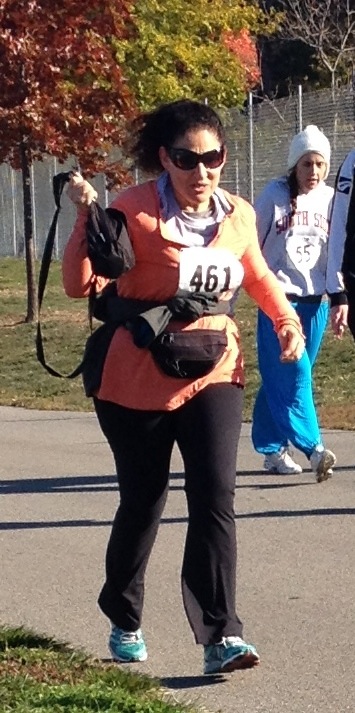
And, then this past weekend, I ran my first races.  Yesterday I walked to Randall’s Island and slowly but surely ran the 5K, or 3.3 miles.  Because I am so slow, I had a lot of space between me and the next runner.  I happily passed walkers, but wasn’t even close the other runners.  I didn’t care.  This was for me, and I could put one foot in front of the other towards the finish line. 

It felt good to complete the race.  Larry, my husband, and Lucy our Tibetan Terrier were there to cheer me on coming an going.  It was so nice to have them there.  And, today I was in Central Park to run a five-mile race.  I don’t know my time.  I didn’t even bother to find out.  For me, the fact that I was there was enough.  I have no designs on a marathon.  Being able to run at all is a win for me. Image

Mood Minders

Weight Watchers is known in the diet arena for their Points Plus platform. Inspired by their model, I am introducing my own points program.  It is a diet, but not of the food variety.  My points program is based on overall attitude rather than foods and exercise.  I am naming it “Mood Minders”™, an alliteration to assure successful branding. 

            Mood Minders”™ works like this.  We start out with twenty points per day, with an extra 40 points for the week to use at your discretion. You can use a portion of your weekly points daily, or you can save them up and have a full fledged tantrum at the end of the week, if you like. 

Neutral moods are zero points.  So if I’m observing a situation but not getting upset or making it personal, then it’s a zero points experience.   For instance, if I’m watching a driver parallel park on my block, and I notice they must be from the suburbs where they normally park in a lot, but I am not critical of the many maneuvers they make to come as close as 10 inches from the curb, then it’s zero points.  However, if I make a nasty comment to my husband and we banter on about our superior parking acumen as compared to the shnook in the car, then it goes from zero points to costing me four points.  Two points for being catty, two points for innocuous gossiping.  Cruel gossip can cost as much as ten points, since it’s not just a mood, but can be mean spirited. 

            We earn the most points, eight, by volunteering, random acts of kindness, and true forgiveness.  Laughter and joy earn us a hefty five.  Patience and generosity are also worth six points.  And, the good news is patience for yourself, as well as for others, is counted as well.  I was able to earn my six points when I made a mistake in my Mood Minders™ meeting by pronouncing omniscient, “omni cent.”  While being corrected by one of the self proclaimed intellectuals in the group, I felt my face flush, thanked him for correcting me, and smiled meekly.  If it weren’t for my minding my points, I might have made a pathetic excuse, while silently cursing him for saying anything.  Instead of costing me points, I gained points, forgiving myself for my error, and forgiving him for using my mistake to show off. 

            Based on my new program, my well wishing to Weight Watchers gave me three bonus points.  I can later use those points in the event I find myself being critical, like when I ask tight-lipped that my husband pick up his dirty socks, again, as I did yesterday and the day before that.  Of course, a program as rigorous as Mood Minders™ should be done with the support of a group and a group leader (me).  Note:   I do not lose any points for arrogance since I did not claim to be a great leader.  I merely stated my role within the group.

Let’s take a look to see how some of patients, I mean Mood Minders™ group members, have fared. 

Norma wasn’t quite depressed, but she was constantly comparing herself to others, whining that her life wasn’t as good. She had been known to describe herself as miserable. This always cost her four points, two for complaining, and two for burdening others with her gloom. It took the loss of many points in meetings to get Norma to finally track her points.  She as appalled and dismayed to find out that while she viewed her misery to be the fault of others, in the end she was in a points deficit herself.  She started recording, and has now created herself anew.

Then there’s middle-aged Paul.  He was a rageaholic.  If something didn’t meet his expectations he would yell, bullying others to change things so he could be appeased.  He would become virtually apoplectic when on the phone with his cable server when there was a service failure.  But once he started working the Mood Minders™ technique, he thought twice before he reacted.  He realized he had a choice about instantly becoming irate.  He learned to take a moment before reacting.  He started to think before he went into a complete frenzy. It’s not that Paul doesn’t ever get angry anymore.  But he knows he only has a certain amount of set points for his rage, so he judicially uses them when a situation is worthy of that response.   Paul can now manage to stay relatively calm when speaking with his IT manager, even when his computer is on the fritz, because he knows that being patient with him will help him get the result he wants.  He still yells at sales people from time to time.  But not always, and never in the few hours on Tuesday before he attends his Mood Minders™ meeting. 

Amy started Mood Minders™ when her anxiety was at an all time high.  She was a worrier.  Once she found out that she could earn points for laughing she had would intersperse her angst with mirth.  She stopped frowning as much, saving her countless thousands in botox injections.

Although Norma, Paul and Amy are a mere sampling of the possibilities of Mood Minders,™, there are all kinds of unhappy people. And, if you’re reading this and thinking you are above Mood Minders,™  Think twice.  Self-righteous indignation is a lonely path, and a holier-than-thou attitude will cost you a hefty 5 points.  But by following MM’s simple outline, life can be more enjoyable.  


A quick outline of Mood Minders™:


*You have the power to choose how you react to situations.

*You can minimize your unhappiness, and maximize pleasure

*You can still be miserable, if you like, your points are yours to use


Zero point moods:

Feeling your feelings without judgment, Observation, patiently waiting

One Point:  Mild annoyance, Apprehension, Slight Impatience, Boredom

Two Points: Rolling your eyes at someone’s comment; having a bit of a snide tone when speaking

Three Points:  Defensiveness, Being Judgmental

Four Points:  Mild Gossip, Self-righteous Indignation

Five Points:  Being a Naysayer, Help-Rejecter (Someone who asks for help, then when given the help they reject the offerings)

Six Points:  Quitting Because You Don’t like the Probable Outcome, Bragging at the expense of Someone Else, or Trying to Look Better than Another

Seven Points:  Scaring Another with Your Anger; Scaring Yourself by Coming Up with Worse Case Scenarios

Eight Points:  Intentional, mean-spirited gossip; Laughing At someone in public

Above Eight Points:  Taunting, Bullying, Spiraling with Fear or Anxiety, Saying hateful things to yourself


**Bonus Points**:

One: Refraining from Sending Superstitious Chain emails; Smiling

Two: Small forgivenesses; Being a Good Sport

Three: Giving Compliments; Writing Thank you Notes

Four: Keeping Your Judgmental Opinion to Yourself

Five:  Full-out laughter; Spreading joy

Six:  Patience; Generosity

Seven:  Good Manners; Being Gracious

Eight:  Volunteering; Random Acts of Kindness, True Forgiveness

Joyous Laughter, Glee, Volunteering, Random Acts of Kindness, Forgiveness, Complimenting others, Taking responsibility for one’s actions, Giving Anonymously to Charity, Charitable Giving (less of a bonus, but on the plus side, nonetheless)


If you want more information, or you think the Mood Minders™ itinerary is right for you, you can become a founding member of Mood Minders™ for a generous fee.  The high cost will ensure you extra weekly points since you will be contributing to the growing prosperity of this amazing program.

No Problem Rant

Unknown Last week I visited a museum.  I was excited to see a new exhibit.  I went to the membership desk to get my pass, and was partially greeted by a 20-something intern or part-time employee.  She was having a laugh with a co-worker and was in no rush to help me.  After she finished her exchange with the other intern, she turned to me, looked at my card, and gave me my day pass.  I said, “Thank you.”  Though perhaps I was less gracious than I would have been for a more professional interaction. She said, “No Problem.”  unfortunately, this is not unusual.  When did “You’re Welcome” become ubiquitous?  When I thank a service provider what I now often get in return is “No Problem.”  As in “Thank you for helping me with the party.”  Mary was hired to help serve and clean-up at a party we gave this summer.  At the end of the evening, I thanked her for the work.  She responded with “No Problem.”  My thought was, it shouldn’t be a problem, it was your job.  “My pleasure,” is an appropriate response.  “No Problem” should be reserved for those times when you want to put someone at ease.  When my friend takes me out to lunch and I thank her, she says, “No Problem.” Lovely.  It is a kind response and it equalizes the imbalance of having her pay.  When my cousin went out of her way to visit my parents, and I acknowledge her for it.  She said, “No Problem.”  It was generous to say that since she spent time and took the time and effort to do a nice thing.  However, more often I hear “No Problem” in situations in which there was never an implied problem in the first place.  And, I hear this all the time, at the grocery check out,  the coffee shop, restaurants, sales people, help desks, and more.

The only time I want to hear, no problem, is when a friend has done me a favor and I thank them.  Then  “No Problem” is a wonderful response.  But doing one’s job is not doing me a favor. It’s Your Job!  I assume it is not problem for anyone to do the tasks that make up the job and for which he or she is paid.  If it is a problem, perhaps getting a different job is in order.  I miss good service, and helpful staff.  It may be generational.  And, if so, let’s err on the side of manners, and have that be “No Problem.”

Shoulds

I am writing a blog post because I have a list of Shoulds, and posting on my blog is on the list.  It will be a short post, after all, I have a lot of shoulds.  I was supposed to get some paperwork done for my practice, but that’s been on my list for weeks now.  This weekend is the hard deadline, so I’m certain that will get done before I hit the pillow tomorrow night.  Some shoulds stay on the list, and I know I should let them go, but I’m not ready to quite yet.  Just like I should get rid of clothes that linger in my closet years since I’ve worn them last.  But they each have a story.  So I give away enough to alleviate my sense of should, but not enough to create  a lot of new space in my closet.  I can easily become overwhelmed with all that has to get done.  The shoulds come after the “have-to”s.  Some things I have to do, also don’t get done.  I don’t make dinner as often as I used to.  I used to write thank you notes, but I know I’ve missed communicating my gratitude recently.  I don’t drink enough water.  And, I need to have more patience, not only for what will eventually get done, but for what will never happen.  Should I go on?

It’s All About Me

I’m zipping down Park Avenue.  Now I’m on 54th Street trying to cross during a grid lock.  I glare at the driver of the black SVU, as I choose which end of the car is safest to pass.  Okay, the front, I think.  There’s barely enough room from his bumper to the Volvo in front, but I make it past only to get to the other side where there are fur junior executives side by side blocking the side walk.  I’m going at a clipped pace, and I don’t like to be slowed down.  I wait for the guy on his lunch hour to pass going the other way, then I aggressively move past the four juniors and go right in front of them to let them know they’re blocking the sidewalk. 

            There’s nothing that gives me greater pleasure than walking In Manhattan.  I feel free and carefree.  It’s great to pick up speed while walking, listen to a book, a podcast, or good music, while going from block  to block, surprised I’ve already made four miles.  It’s my favorite way to decompress. 

            On the other hand, I’m realizing how I resent anyone getting in my way.  I feel like I own the city, and I take it personally when others aren’t mindful that they are not the only ones on the block.  There are the slow moving tourists, the entitled young professionals on their way for frappuccinos, and teens hanging with no room left for pedestrians.  However, the worst are the moms and nannies, tow-and three deep with Mercedes strollers.  They hinder anyone who wants to walk down any given block in residential areas.  

These are the certainties of walking in the city.  I hadn’t realized I was taking something that means the world to me, and turning into an exercise of futility.  There’s rarely a time I don’t encounter some obstruction.  I made it personal.  I saw their obliviousness as something to be challenged.  I wanted to awaken the unconscious amblers to their foolish ways.  But I realized I’m simply a righteous foot traveler.  I’m in it for myself, and anyone who gets in my way, anyone who is doing what they do for themselves is the enemy.  Nothing relaxing about that.  Do I find I need conflict?  Apparently so.  After witnessing myself get all self-righteous in contrast to the unknowing, I am on a mission to transform my walking life. Will I have patience with myself as I begrudgingly let go of my abhorrence of the inevitable?  Only time will tell.   I am preparing to learn to go with the flow.  I don’t know if I will, but that’s the plan, and I’m sticking to it.


Being Right

“Ooh, Ooh,” I moaned with my hand raised high, wishing for Mrs. Mishaw to call on me. 

“Silence. I do not call on anyone who is making noise,” Mrs. Mishaw said in her snipped, stern tone.  She was wearing a straight knit skirt, in brown, of course, a starched blue blouse with a peter pan collar with darker blue piping, and thick stockings with brown, medium-heeled  pumps.  The heels clicked on the over buffed wooden floors as she went up and down the aisles with her pointer.  Always with her pointer. 

She did not call on me.  It was only when I didn’t raise my hand and hadn’t been paying attention that she called my name to shame me in front of the class.  Like when we were talking about The Call of the Wild, a book I could barely get through.  My interests and tastes as a third grader were more in line with biographies of Helen Keller and Eleanor Roosevelt.  I wasn’t moved by adventures.  As I looked out the window at the moving clouds, while pulling my curls around my right index finger, I was brought back in the room by a loud, “Miss Dubin, what do you think?”

“I don’t know.”  I said in a whisper.

“Speak up, Janet.  Your classmates are waiting for your answer.”

My throat hurt, and tears were welling up at the corners of my eyes.  Though it was hard to get out, I said, “I don’t know, Mrs. Mishaw.”

“That’s right you don’t know. And, do you know why you don’t know?” she asked.  I knew enough at that moment to remain silent. 

“You don’t know because you were not paying attention.  Little girls who do not pay attention do not do well at school.  Do you understand, Janet?”  she asked, more as a threat than an inquiry. 

Third grade was not an easy year.  I respected her authority, but I hated going to school each day.  I couldn’t stand someone, even of she was my teacher, who treated me and some other choice students with overt cruelty.  After leaving Mrs. Mishaw’s class I became devoted to having the right answers when I needed them.  I learned to show how smart I was.  Even as an adult I will volunteer information so I can be admired for what I know.  Though, it’s really more than that.  I think I want to be acknowledged for mattering.  Mrs. Mishaw taught me, wrongly, that I would only be acknowledged for what I know. 

I now have to discipline myself to be curious.  It is not easy to stop proving what I do know, but rather be open to what I can learn.  As a psychotherapist, I have to balance being a knowledgeable professional with sitting and learning from my clients.  My clients teach me this again and again.

They are the experts at being themselves.  I can make interpretations, but I can’t know better than them.  If I am arrogant enough to think I know better, as I sometimes can be, I am always humbled by my naiveté.  When Louis came in and told me he cheated on his wife, my first assumption was that he had to repeat the behavior of his dad that caused his parent’s divorce.  And, even, if in theory, that was perhaps true, it was not useful information for the session   The truth that came out as I listened to Louis was he was afraid he couldn’t be loved.  And, as far as he was concerned, his actions were proof of that.  We had to work on separating his actions from his true self, so that he could forgive himself and face his marriage with honesty.  We would never have been able to get there if we went with my assumption. 

It was easy to size up Mandy analytically.  Mandy was a 31-year-old binge eater, who felt lonely, and often rejected. Her mother was always putting Mandy on a diet, only complimenting her when Mandy had starved herself enough to lose weight.  Mandy was certain that she had no personal redeeming qualities, given her size.  I thought that she always felt rejected because she internalized her mother’s focus on her weight.  But no one is that simple.  In listening to her over the course of two years, I found her courage to endure daily bullying at school, and disapproval at home, both moving and inspiring.  She developed a stalwart strength and a determination to get through adversity.  Though lonely, she was able to find joy in doing things alone.  She could have easily been bitter, but instead was moving forward in her life.  Again, I learned so much from her, when I could have easily pigeonholed her, much as her mother had.   

As I’ve learned, knowledge is a useful tool, but it’s no substitute for consciousness, culled by curiosity.