Finding Peace, The Fifty-First Week in the Second Year of the New Abnormal

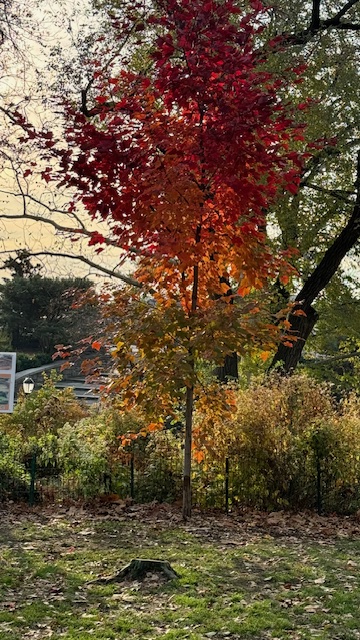
This week I’m sharing some past sunsets.  Seeing sunrises and sunsets makes me smile.  Sunsets remind me that nothing is permanent.  And sunrises are an apt metaphor that we always have a chance at a new beginning.  Both sentiments give me some peace.  And we could all use peace.

Too often when thinking of global peace we think it’s up to world leaders.  Or we can feel the futility of hoping for peace.  It’s easy to feel powerless when there are wars in too many regions of the world. When anger and hate fill our media outlets peace can seem allusive.  As a child, as with many of us, we learned the lyrics “Let there be peace on earth, and let it begin with me.”  I sung that song by rote.  I didn’t really think of what I was saying.  I found the tune bland.  I was not inspired.  And, yet, now when I hear talk of peace, and other songs referencing peace, I’m uplifted.  

Perhaps we can start with a smile.  It’s a small act, but it’s something we can offer.  There is a happy meditation that suggests we smile when we breath.  It changes our perspective and allows us to feel a bit lighter in the process.  And when we share a smile it brightens up someone else’s day. In the past I might smile from time to time, feeling good when people smiled back.  Admittedly I was resentful, as if I wasted a smile, when a blank stare or an unsmiling face looked back at me.  But I can’t really know if it was a wasted smile.  They may have had a delayed reaction.  In that case, I wouldn’t have been privy to a positive impact.  These days, I do my best to simply smile.  I don’t always get a smile in return, but when I do, I am doubly happy.   

 I suggest we all start smiling.  It may be an act of disruption since there has been a trend towards frustration, ire, and apathy.  But we can pierce through the murkier emotions and land on a piece of peace. 

This is not to say we should deny our feelings and err on the side of looking on the bright side.  That does nothing but perpetuate the murkiness.  Instead, we can acknowledge how hard it’s been and still share a smile with ourselves and others.  News cycles always use fear and anger as their hook.  Let’s lead with a smile, letting kindness be the hook.  Let’s nourish our joy rather than feeding our fears.  It’s a small step that can lead to collective inner peace.  

Self-Care Tips:

  • Take three deep breaths smiling while breathing.  See if it changes how you feel.  
  • Challenge yourself to smile at others and see how it feels.  What comes up for you when they smile back?  And what happens when they don’t respond positively?  Take note of your feelings.  Then challenge yourself again to share a smile.  
  • What makes you smile?  Remember to watch, read, listen to, or enjoy whatever makes you smile.  

Forgiveness, The Fiftieth Week of the Second Year in the New Abnormal

As the year approaches its end, forgiveness is on my mind.  I find that forgiveness is a process, though I used to imagine it was a one and done affair.  I earnestly believed that I could forgive someone and then I’d be okay with them.  I found that not to be the case.  It was easier to forgive if the person made changes.  Meaning they either stopped the offending behavior, or they started acting in a way they had avoided prior. 

When I was younger, probably, post three-years-old and before I was forty, when I did something that was not thoughtful of another and then was found out, I begged for forgiveness.  I needed to be forgiven to feel I could go on.  This may have come because my mother, known to others as being kind, was particularly unforgiving to her daughters.  One year I snuck into her bedroom closet to see if she got me a smart doll I coveted.  I couldn’t find it, but she found me in the walk-in, and then I made up a pathetic lie.  

When Hanukkah arrived the following week, I watched my sisters and brother open their gifts as I craved something to unwrap.  For seven evenings I sat with them hoping that night would be the night I would be forgiven and be handed a present for the holiday.  She begrudgingly gave me a gift-wrapped box on the final night.  And I acted as if the plaid pajamas was the nicest thing I owned.  

Now I understand that she was raising four children on her own since my father worked so many hours. And I had robbed her of one of the few joys she had as a mother, surprising us with gifts she secretly picked up while we were in school.  Plus, she was an honest person and lying was something she couldn’t abide.  I don’t know if she ever forgave me, or if my father pressured her to give me one gift.  Or, if neither were true and I simply needed a new nightgown, but I hugged her as if my life depended on it. 

I understood the power of forgiveness.  I made a point of forgiving, or acting as if I had forgiven as I soothed my soul until I could forgive.  And then I learned how forgiveness is something we give ourselves.  It takes away the negative feelings we harbor.  It releases us from the past so we can live lighter having unencumbered ourselves of umbrage.  My mother and I enjoyed that freedom as I matured, and I was able to appreciate all she had given me.  

Forgiving is not forgetting.  Forgiving is about not weaponizing past behaviors, of others or ourselves.  Forgiveness is an act of self-love.    We care enough about ourselves that we will not allow the past to hold us down.  And, yes, it’s a process.  Sometimes I have forgiven Larry, my husband, because he hadn’t thought of me when I wanted to be considered.  But I was not ready to let him know I forgave him.  I was still processing that forgiveness.  I knew I was in the final stages when I found my sense of humor and could own my part in our dynamic.  

And, though there is so much more to forgiveness, please forgive me for this short set of thoughts at the end of this year when too many have experienced way too much hurt.  For more on the subject, Harriet Lerner’s Why Won’t You Apologize is an excellent book on the subject.  

May we all find lightness of being by unshackling the burdens of our resentments.  Warm wishes this holiday season wherever you are in your path of forgiveness.  

Self-Care Tips:  

  • Read, reread, or listen to Harriet Lerner’s Why Won’t You Apologize.  Or listen to her TED talk:  https://www.youtube.com/watch?v=5r6Y9uhmL6Y
  • If you’d like to forgive, have compassion for the pain and upset you’re experiencing.  Caring for yourself is an important step in forgiveness.  Malachy McCourt’s quote is a great reminder of the power of forgiveness: “Resentment is like taking poison and waiting for the other person to die.  
  • Taking action in the service of others, like donating to a beloved non-profit, volunteering, being kind to a stranger, are great ways to work on self-forgiveness.  

Ahhh, Naps, The Forty-Eighth Week of the Second Year in the New Abnormal

Napping was my top priority this past week.  They were usually twenty to thirty minutes max.  They made a tremendous difference in my mood.  I was able to get through the week with a greater capacity for patience.  I had more room for the things that usually get under my skin, like loud car horns in grid lock, or the annoying overspill from packages protected with shredded paper or other messy stuffing. 

There’s nothing like a good nap.  It can be rejuvenating, especially when it’s been a long day and I’ve been short on sleep.  This past week rest was in order.  Life is full, which is wonderful, however, I need to pace myself.  Previously the learning curve has been slow going when it comes to pacing.  So, to get into a supportive pace I took naps where and when I could fit them in.  

I know I need the sleep when it’s so easy to fall asleep and I feel refreshed upon waking. For years I’ve prioritized movement over rest.  Now I’m working on finding a balance so that I am energized when in motion and I am naturally tired at the end of the day, allowing for a restful night.  Stress can interfere with sleep.  And there’s been no lack of stress for so many of us these last months and even years.  

I may not be able to control the amount of stressful circumstances that come my way, but the napping helps me to handle it better than when I’m sleep deprived.  As a moody person, I will continue to minimize the low moods by getting the naps I need.  

Self-Care Tips:

  • Close your eyes.  If it’s an easy moment, open them again and see if you can look at the surrounding space differently.  Maybe you can notice something you didn’t see before.  
  • Close your eyes.  If you automatically feel sleepy, think if you cannot do something so that you can take a short nap. 
  •  Close Your eyes.  Imagine a world in which kindness, respect and peace are everyday norms.  Then as best you can, embody those values throughout your day.   

Spilled Coffee, The Forty-Seventh Week of the Second Year in the New Abnormal

I spilled my coffee earlier this week.  And I then let out a loud string of expletives to vocalize my frustration.  I cleaned up the mess and then rushed to work.  Not the way I had wanted to start my day.  My reaction, though provoked,  made it clear that I need some down time.  It may not be the vacation that I’ve fantasized, but even an evening in, or a task free afternoon will do at this point.  

To that end, this will be a brief post.  I will not be replying to comments.  I will be choosing to do less.  Since I have a history of blurry boundaries, stating this upfront may seem clumsy, but at least I’m stating what I need.  

Too many of us, particularly women and marginalized populations, try to keep up, which can keep us down.  I invite you to join me in taking time off, even a fifteen-minute break.  Perhaps if enough of us did that we would see less negative reactivity in our worlds.  Less acting out.  

Taking a time out, which for this adult is a gift not a punishment, will allow me the space and time to regroup.  So if I spill my coffee again, I may be able to offer one expletive, rather than an endless string.  Then I hope to simply get a towel and soak up the liquid.   

  • Should you notice you’re more reactive, find time for a short break, or, if possible, take a longer period of time off.  
  • Before making more commitments, say, “I’ll think about it.”  If you’d still like to do it, and it’s not an obligation, you can get back to them and say yes.  However, if it doesn’t bring you joy when thinking of the potential commitment, see if you can abstain from saying yes.  
  • If someone reacts in an upsetting way, try not to  join them.  Wait until a later date to let them know how that reaction impacted you.  This way you have a chance of being heard and understood. 

Nature Speaks, The Forty-Sixth Week of the Second Year in the New Abnormal

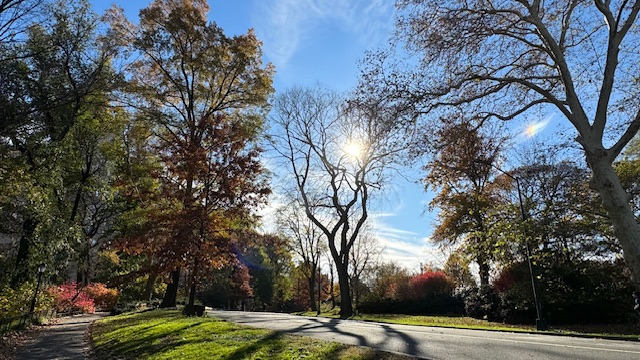
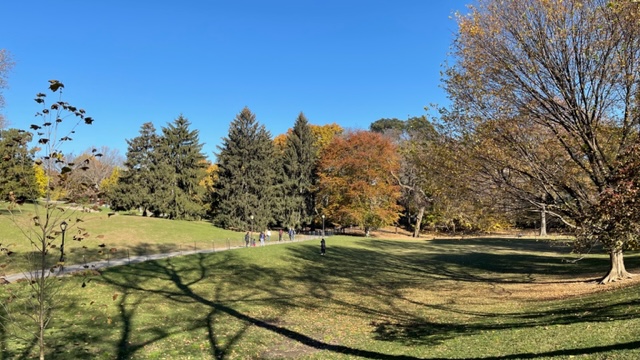
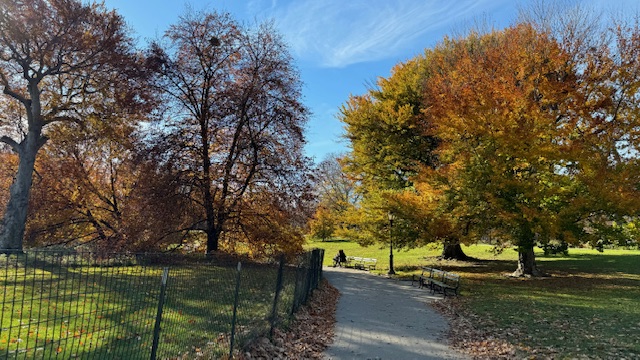
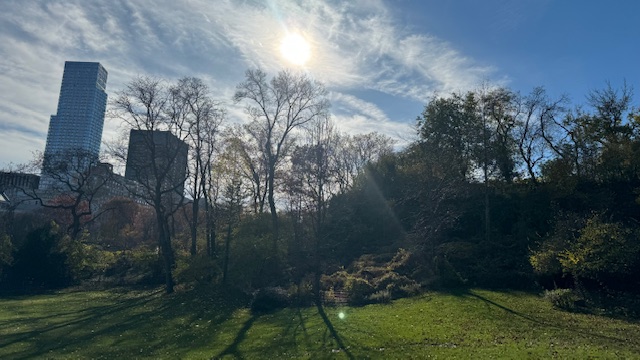
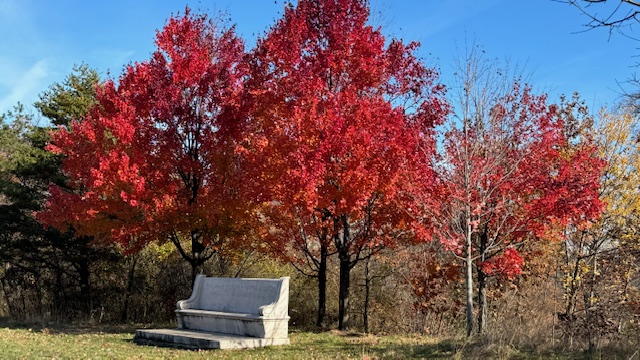
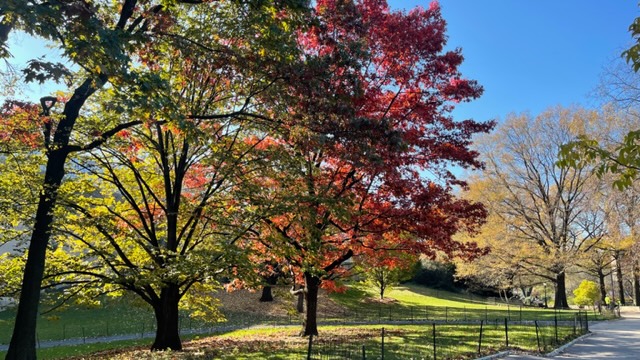
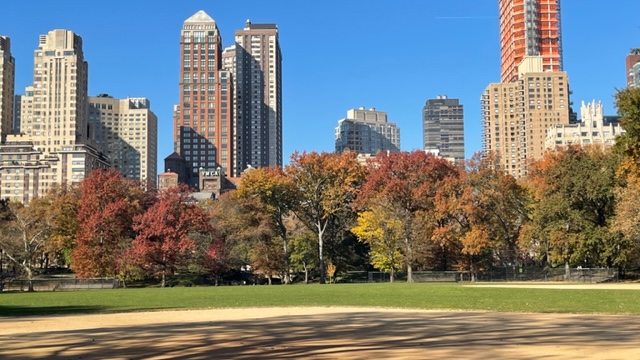
Autumn colors fire up Central Park.  I had the good fortune of walking through the park on several occasions this past week.  I was reminded that this season represents the last of the foliage as the trees and plants prepare for the winter.  Following winter comes a renewal as Spring brings greenery and flowers to enjoy.  Just seeing the colorful trees brought hope. 

 I realized that whatever hardship I’m going through, whatever darkness we’re witnessing in the world, change is inevitable.  For that I am grateful.  

“This too shall pass” is a wonderful mantra.  The more we face adversity, the more important it is to remember that whatever we’re going through is temporary.  When we’re in the eye of the storm surviving may be our first priority.  But as we get through it, giving ourselves grace, meaning making room for our experiences, we come to know that there are subtle shifts that take place along the way.  

I remember many long drives on the weekends of my youth.  The six of us would crowd into the car.  My father was first to get in, my mother last. Sometimes my dad would move our Ford station wagon down the driveway to indicate that he was ready to go.  The car smelled of wet boxes and stale mints.  I liked the far back, looking into the rear window seeing where we just passed.  In the Autumn months I got bored on the roads with few signposts.  As my mother waxed poetic about the turning leaves, I was only taken by the deep red tree coverings.  

It was only years later in my adulthood that I could appreciate the beauty of Autumn’s majestic transformation.  And this past week the visual display shifted my perspective.  Simple gifts of nature make such a difference.  

Self-Care Tips:

  • When things are tough and you’re able to take it in, remember that “This too shall pass.”
  • Look around the natural world and breath in the gifts you see, hear or feel.  
  • Keep scents close by that induce calm.  I love vanilla, as well as my rose and almond oil hand soap.  How about you?  

Consciously Unconscious, The Forty-Fifth Week of the Second Year in the New Abnormal

I was taken off guard.   I thought I was going through present difficulties consciously.  I was meditating.  I was practicing gratitude.  I was reaching out to friends.  And, yet the combination of a dear friend dying while adjusting to Larry, my husband, having a serious injury, along with the horrific world events, had me spiral so that I made poor choices, acted impulsively, inadvertently hurt others, all while losing sleep.  My reactivity was to repeat the pattern these last two weeks.  

If I hurt you, I am very sorry. It is said that we can do better when we know better.  It would have seemed that I knew better.  I did not.  I was in a fog of denial that prolonged my suffering.  I wish I could say that I was kinder and gentler after I hurt others. Sadly that was not the case.  It was only when I was being so hard on myself that I recognized very old behavior.

There is a hubris in believing that we are immune to unconscious behavior if we’re “doing all the right things.”  Being human is a process of uncovering our unconscious parts.  It took a trifecta of stressors to have me dig deeper.  Boy, am I humbled.  

Since I am in the middle of learning what I have to learn to grow now, I have no wisdom to impart.  I suppose I can share that we don’t know what we don’t know.  I am hoping to continue the learning process so that I do know better and therefore can be better.  These present life lessons are knockouts.  I am getting up slowly to face them, hopefully with more compassion and kindness.  I need that now.  From what I’m seeing, we all need that now.  

Self-Care Tips: 

  • If you are being hard on yourself, pause.  Ask yourself what’s upsetting you?  Is hurting yourself with thoughts familiar to you?  Has it worked?  (It’s never helped me feel better.)  What can you do that includes self-compassion and kindness?  Then try it.  
  • If you find you’re very reactive, getting upset easily, understand that these times might be hard for you.  See if you can give yourself a break.  When necessary warn those around you that you’re sorry but you may get upset easily.  And when that happens take the time to repair the damage if others are amenable.
  •   Forgive yourself. We’re all human.  We can learn so much from feeling shame, ending the cycle of being mean to ourselves because we made troubling mistakes.  That is how we learn and grow. 

I am a Jewish Psychotherapist, The Forty-First Week of the Second Year in the New Abnormal

Do I speak of the unspeakable?  This past week marks a tragic low in inhumane acts.  I cannot get my head around it.  As a Jewish psychotherapist I am in a similar position as I was when we faced the pandemic.  I am going through something that I am also hearing from my clients.  The sadness, along with so many other emotions, have been omnipresent this past week.  

Since there are so many experts writing and speaking about the issues surrounding the terrorist attacks, I will not even try to address it head on.  What I can speak to is how now more than ever we can attend to our mental health.  We can care for ourselves with the utmost respect.  We can be gentle and kind.  Patience is required as we may seek out numbing agents or distractions while feeling emotionally overwhelmed. 

Taking life slowly for the moment may allow for processing the pain while creating openings for the small joys of any given day.  Walks have felt particularly therapeutic to me.  I have gone to take in artwork, and I am listening to more soulful music. Rest has been mildly restorative at the end of my days and at the conclusion of my work week.  I hope you will find the people and things that comfort you.  As citizens of the world we are all impacted one way or another by this and other atrocities.    

I pray for accord and wish for every innocent person to thrive on a peaceful planet.   

Self-Care Tips:  

  • Move slowly through the world.  The movement will help with stress release, and being embodied helps locate and address your current experience.  Gentle stretching, walking in nature, dancing to music that moves you are all suggestions for your body and soul.  
  • Reach out to those you care about.  Ask how people are doing.  If you’re overloaded, no need to ask, you can simply let them know you’re thinking of them. 
  • Pray and meditate.  If you are a non-believer prayer can simply be taking in the world around you. Become acquainted with your inner and outer selves as we heal individually, and ultimately ,we heal for all humanity.  

Saying Nothing, The Thirty-Ninth Week in the Second Year of the New Abnormal

“If you don’t have anything nice to say, don’t say anything at all.”  That was a common idiom of our mother’s lexicon.   She lived true to that statement.  Even when she attempted to comment on something she disapproved of, she did her best to soften it.  As a teen, I often was asked the question, “Janet, do you think that’s the most complementary outfit?“  Or it could have been make-up, pants, hair style or any other appearance-related observation.  As a sensitive teen I was crushed no matter how much she tried to say it diplomatically.   

I was not mature enough or confident enough to understand that we were separated by a generation, and our aesthetic tastes were informed by those differences.  Nor did I appreciate that even when well-intended, a critique said in the most unobtrusively terms, can still be judgmental.

I learned that the hard way.  I followed in my mother’s footsteps, not saying anything that wasn’t nice, but Larry and Alex, my husband and son, let me know that my expressions have screamed disapproval.  So, though, “don’t say anything if you don’t have anything nice to say” is step one in being thoughtful, it by no means is enough.  

I have had to learn to listen and see things from their point of view.  I may be able to see that what they say or do isn’t right for me, but it is not my place to judge what is right for them, or anyone else, for that matter.  

We’d all do better to focus on ourselves and what we can do to live our lives as best we can rather than determine how others should be living their lives.  Whether we cast aspersions on others out loud or via facial expressions and body language, we are only indicating that we, ourselves, are intolerant or judgmental. And that is never a pretty look for anyone.    

Self-Care Tips:

  • When you hear something that sparks negative feelings within you, do your best to set them aside as you listen to the other person so you can appreciate their perspective on choices they are making.  You might learn something helpful rather than be reactionary, which usually changes nothing. 
  • I suggest watching the docuseries Chimp Empire. On Netflix, if you have it  It’s a relaxing view, while still creating a nice level of drama in the chimpanzees’ lives.  
  • Since we are our own worst critics, see if you’re able to bring kindness and compassion when you’re feel critical of yourself, and do your best not to criticize yourself for not being kind enough.  

Bickering, The Twenty-Seventh Week in the Second Year of the New Abnormal

My son told me last weekend that he hoped he won’t have disagreements in his relationships like I have with my husband when he’s older.  It was interesting to hear, and as far as I understand he believes that with the amount of therapy, mindfulness practice, as well as the fact that I am a psychotherapist, I should be further along in my personal development, especially when it comes to my marriage.  There was a time I would have agreed.  I would have seen my defensiveness when my feelings are hurt, and that my feelings get hurt at all, as a fault in my character.  

I am not proud that I bicker easily, or that I am quick to react, but I am no longer ashamed that both are true.  Like Alex, I imagined that when I was in my sixties I would have life figured out.  I believed I’d be highly advanced in my communications, and I’d be able to easily respond with patience and self-reflection.  The truth is I am still learning.  I have more acceptance of the bickering, appreciating that our marriage has the strength to encompass unpleasant moments.  However, more time is needed to learn to have a sense of humor about myself, to find ease when I want recognition and appreciation, and to accept that my way is not the only way.  

In our twenty-six years of marriage Larry and I have been able to spend less time upset with one another. Repair is quicker and easier.  And we laugh a lot more together.  I am proud of that growth.  We married later in life, but we came together with much to learn about healthy relationships.  And we continue to learn.  Every conflict is a new opportunity.  

I appreciate Alex’s comment because it allows me to see how it looks from his perspective.  I can only imagine the impact our bickering caused him unable to escape it in his earlier years in our compact apartment.  Presently his opinion and my response to conflict allows me to find acceptance with the imperfections of being human.  Being a therapist does not mean I’m immune to familial disagreements.  It means that I am committed to learning and growing one quarrel at a time.  

Self-Care Tips:

  • Take the same short walk three different ways.  Walk looking ahead on one walk.  Walk looking up.  And walk looking down.  How different are these walks covering the same ground?  This can be a metaphor for our memories.  Though we may remember the same experience, when we are in a different place in our lives, we might view it in a new way.  
  • When you have a disagreement, rather than seeing what is wrong with the other person, ask yourself what you need to feel at ease.  This way you address a need rather than trying to be right or change someone else. 
  • Take an analog and digital break.  Read a book or magazine, hand write in a paper journal, paint with watercolors, play with a real deck of cards, play a board game, knit, play ball, or find a concrete activity off-screen.    

Fathers Day, The Twenty-Fourth Week of the Second Year in the New Abnormal

Happy Father’s Day.  When I say that it conjures up so much for me and for so many others, I expect you included.  Many of us have had varied relationships with our fathers nothing like Father Knows Best, The Courtship of Eddie’s Father, Blackish, or even Home Improvement.  If only we could tune in for 30 minutes a week and enjoy the comical moments that focus on the highlights of the best parts of them, with a little silly thrown in.  

My dad was king when it came to bad dad jokes.  I would groan, embarrassed I had a dad who would even say “Don’t bother. Everything looks good this way,” every time I offered to clean his overly-smudged spectacles.  Larry, though fastidious with his eyewear, has taken on the torch of bad dad jokes.  Usually they’re groaners, but once in a while they make us laugh.  Maybe he’s not comedy ready, but the few good ones could be included in a non-existent situation comedy.  

Whatever our experience is with our dads, good, difficult, sad, troubled, no one is one dimensional.  I will always appreciate my father for working in his shoe store at age twelve and thirteen, my second job following babysitting.  I learned how to work the cash register, count backwards to give proper change, and people watch.  I could see when finances were tight, and the family was spending money they didn’t have to get back-to-school shoes for their children.  We always made sure they got a small toy to go with their purchase.  Of course, Buster Brown customers, the families who could afford new shoes for Autumn, in addition to maryjanes for special occasions, would get a molded replica of Tige, Buster Brown’s dog, or some other brand trinket.  

I recognized the lonely ladies who had difficult feet to fit who came in to find their next slip-ons, even though they would go home with nothing.  My dad worked as hard for them as any of his customers, even as he knew he needed to make his sales to keep his business afloat.  

I learned about hard work, and I learned about the unfairness of life while helping him out at the store.  I also learned how to clean a rug with an overused, old vacuum cleaner.  All valuable life lessons.  

Sometimes our dads inspire us to reparent ourselves.  Their best might not have been best for us.  So we muddle on learning from our mistakes, and theirs, so we can learn to care for ourselves better, as well as others others, if possible.  

Larry is a loving father.  He made sure that Alex benefitted from his music connections to see special shows and concerts.  He learned to love gently and learned acceptance as our son transitioned to a young trans man.  

Parenthood can be a lesson for all of us no matter who our fathers are or were, or even in their total absence.  Parenting is an ongoing process of love, patience, humility, joy, fear, sadness, awe, grief, and so much more.  But isn’t that true of all of life?  

Self-Care Tips:

  • Make a list of what you’ve learned from your father, good, bad or otherwise.  See how that imperfect relationship has shaped you. See if you are able to be grateful for something he/they brought to your life. 
  • Being caring to yourself today.  Reparent yourself in a way that embodies the parent you need at this time.  
  • Laugh.  It can be something dumb like a dad joke, but enjoy a moment of levity today.